One December morning, shortly before the United Kingdom’s 2019 general election, I woke up in South East London to find that every house on my road to the Overground station had a poster in its window calling on passersby to “Vote Labour.”
As an Italian still waiting for British citizenship, I couldn’t vote. But that night I came home feeling optimistic.
“I think Corbyn really has a chance, you know,” I told my girlfriend over a plate of spaghetti, referring to then-Labour leader Jeremy Corbyn.
A few days later, Labour suffered its worst election defeat in decades.
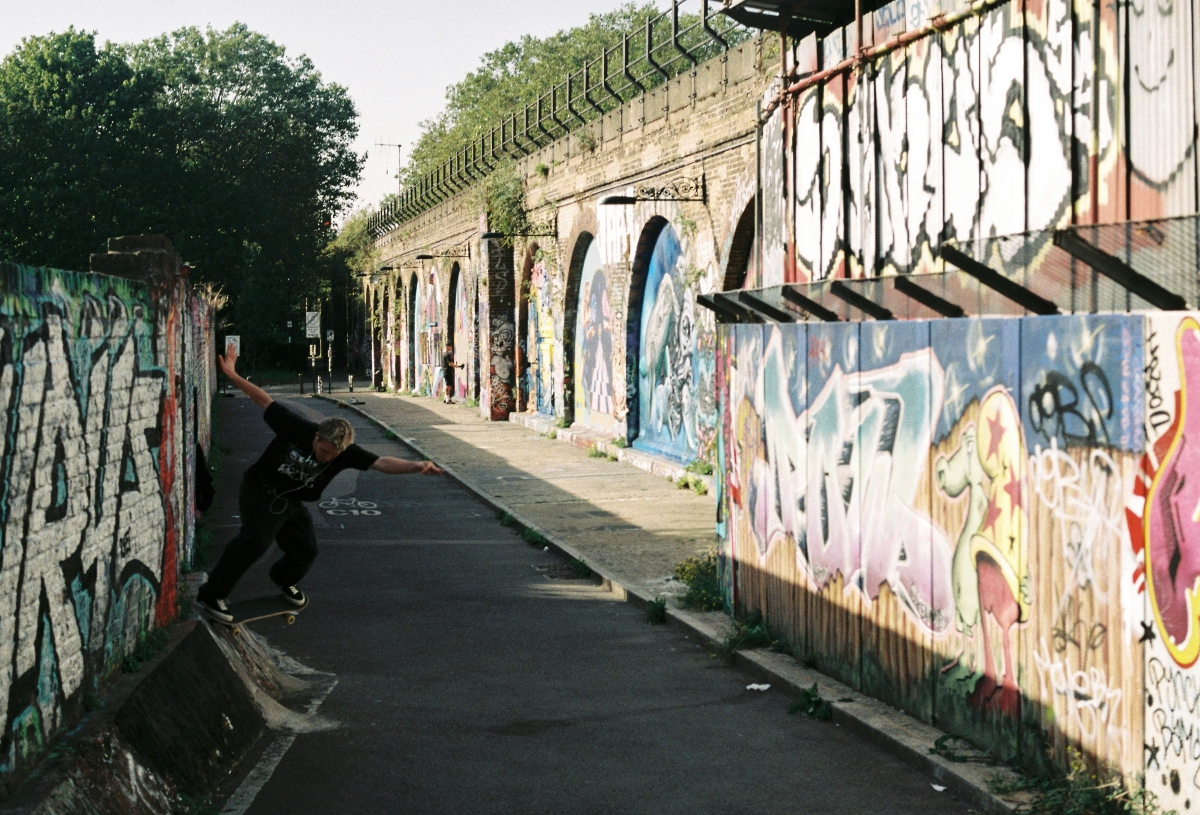
That election taught me what it means to live in a bubble. In this case, my bubble was Lewisham, a borough whose left-wing roots run deep even by London’s standards.
Originally a Conservative commuter suburb, Lewisham was transformed by the Windrush years of the late 1940s to the early 1970s, when thousands of Caribbean Commonwealth citizens were invited to help rebuild post-World War II Britain.
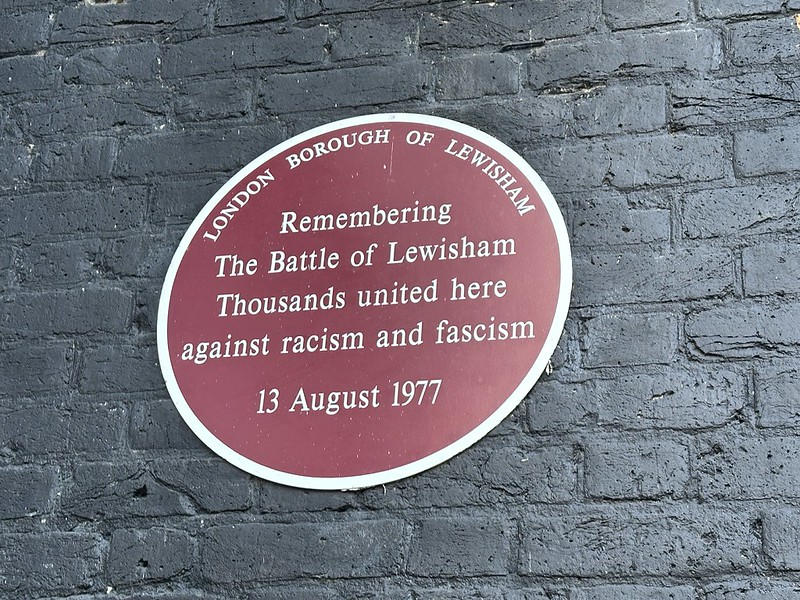
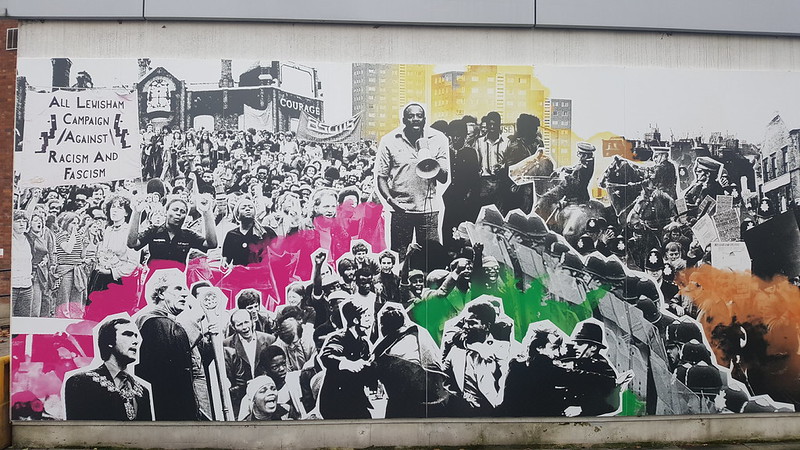
In 1977, Britain’s National Front, a far-right party, marched on New Cross, a vibrant student district in Lewisham, to protest the area’s racial diversity. They were met by anti-fascist demonstrators who greatly outnumbered them. The clashes that followed, known as the Battle of Lewisham, reshaped policing and anti-racism in Britain for years and solidified the borough’s reputation as a left-leaning stronghold.
Labour has run Lewisham continuously since the early 1970s. During the 2019 general election, Labour won 32.1% of the vote nationally. In Lewisham North, where I live, it won 70.1%.
A little (bohemian) Italy
I arrived in Lewisham almost by accident.
In 2016, I visited Fausto, a fellow Italian who had worked with my father and later relocated from Italy to London. Back home, Fausto had been a cook. Now living in London, he had a PhD in Medieval History and ran a then-occupied art gallery with his wife.
In Lewisham, I discovered I liked the dusty Caribbean shops and the artsy, laid-back feel, so different from the bustle north of the Thames.
I’d lived in various places across London since I moved to the city in 2013, becoming one of the hundreds of thousands of Italians living there after the Great Recession. But I didn’t think of moving to Lewisham until a few years after I arrived in London, when my rental situation in other areas became too expensive and unstable.
I haven’t left since.
Fausto was the first of many Italians I would meet in Lewisham through a strange web of coincidences. All are intellectuals of some sort and brandish their leftism as part of their personality. They now make up a good chunk of my London network, all living within a ten-minute bike ride from my flat.
One example is Marina, an Italian sociologist who spent months volunteering for the Zapatistas, a radical indigenous movement in Chiapas, Mexico. We met when we were both invited onto an Italian radio show and realised on air that we were broadcasting from less than a mile apart.
Nobody here acknowledges this web of connections or that it’s linked to the place. And yet we have all been here for years, as if a ghostly force were stopping us from leaving.
Carlo, an anarchist philosopher named after Karl Marx, lives a five-minute walk away and is Fausto’s best friend.
I met Livia, a writer who edits a Marxist magazine, while organising an Italian literature festival in Notting Hill. I later discovered that she had lived at the end of my road for three years.
I could name many more such examples of Italian writers, activists, musicians, and academics who all populate this small corner of London.
In this unlikely little Italian community, you can have breakfast at Carlo’s and argue about class politics, meet Livia to discuss avant-garde writing for lunch, and end the day eating pizza with another Italian writer in Deptford.
Nobody here acknowledges this web of connections or that it’s linked to the place. And yet we have all been here for years, as if a ghostly force were stopping us from leaving.
It isn’t quite a scene. Some of my friends don’t know or like each other. But it is the closest thing to a bohème, or an unconventional, intellectual community, that the current Zeitgeist in London allows. It’s a microcosm of expatriate intellectuals living on the fringes of capitalism, holding onto a vision of utopia against all odds.
But where does that vision come from, and why is it so present here?
The Goldsmiths effect
The answer begins with a physical place: Goldsmiths, University of London, in New Cross.
Founded in 1891, Goldsmiths was a hub of radical student activism by the 1930s. In the 1960s and 70s, the New Left – an international political and social movement that shifted focus from traditional class-based labour politics to broader cultural issues – took root in the university’s humanities and sociology departments, pioneering frameworks for post-colonialism, queer history, and decolonisation.
That legacy remains visible, as does the influence of its avant-garde art department, which in the 1980s launched the careers of notable British artists such as Damien Hirst and Sarah Lucas.
The university’s guiding spirit is Stuart Hall, the Jamaican-British Marxist sociologist who co-founded the academic field of cultural studies in Britain and the publication The New Left Review. Hall never taught at Goldsmiths, but he mentored many of its academics, and the university named a building after him in 2014.
Goldsmiths has Italian connections, too. Among the college’s academics was Alberto Toscano, the Italian philosopher who translated Toni Negri’s ideas on operaismo (workerism) into English. Hall himself was deeply influenced by the Italian Marxist philosopher Antonio Gramsci.
Most of my friends in Lewisham studied or taught at Goldsmiths, and some still do. I myself owe part of my writing career to one of its most influential academics of recent decades, Mark Fisher.
Fisher’s hauntology, a term borrowed from the philosopher Jacques Derrida’s book Spectres of Marx, is the last link in the genealogy of what is known as left-wing melancholia, a haunting sense of political loss and hope that has defined my generation more than anything else.
Left-wing melancholia
When I talk about a bohème, I am half-quoting another Italian, the political historian Enzo Traverso, who wrote the definitive book about left-wing melancholia.
For Traverso, the political Left is defined by its defeats, which leave it mourning the future’s lost promises. Yet the memory of those lost possibilities keeps something of the imagined future alive and, with it, hope of a future victory.
That is the spirit of this corner of South East London, and its love of the past nurtures hope for the future by refusing to submit to capitalism’s logic.
You can see it in the neighbourhood’s resistance to gentrification, in the hammer-and-sickle pins worn somehow unironically by twenty-something art students, and in the anarchist circles that meet in local pubs.
You could see it the morning after that fateful election, when the Vote Labour posters were still waving in the windows like so many red flags, the ‘bandiera rossa’ of the Italian communist anthem.
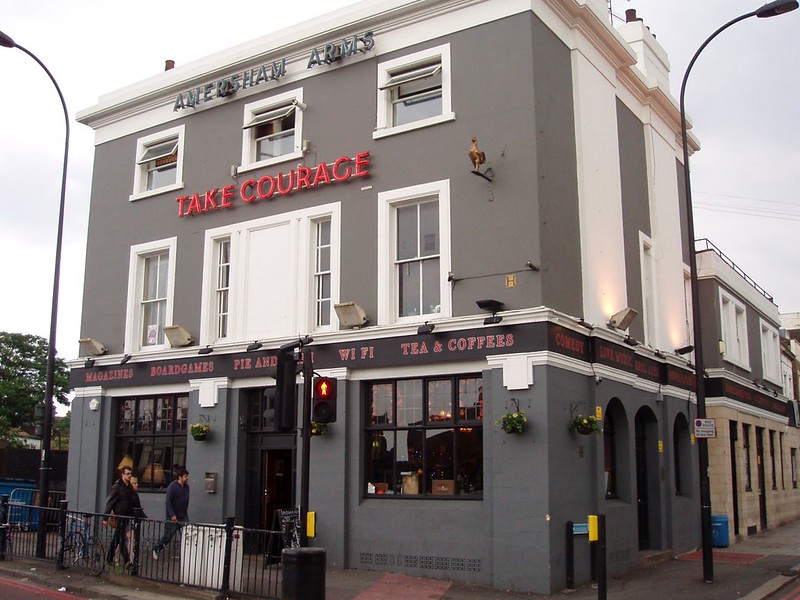
Every day, when I return from work, the Amersham Arms, a pub on New Cross Road, reminds me to “Take Courage”.
For me, it’s an invitation to resist and a reminder that I’ve come home.
Gianluca Didino is an Italian writer and translator based in London. He is the author of La figura umana (Tlon, 2024), Brucia memoria (Quanti Einaudi, 2021), and Essere senza casa (minimum fax, 2020). His English writing has appeared in Aeon, Los Angeles Review of Books, The Sunday Times, AGNI, and Literary Hub. He has translated works by Simon Critchley and Abraham Maslow, among others, and co-curated the Festival of Italian Literature in London (2017–2022).