As the large, white minibus bounces across the pontoon bridge that sits at a confluence of the Tigris River – separating Iraqi no man’s land from the Semalka border crossing in northwestern Syria – it feels more like a casual bus journey than a crossing into one of the most dangerous countries in the world.
Men, women, and children from various backgrounds clutch their personal belongings while balancing cups of steaming-hot chai and coffee.
The atmosphere is relaxed, and many Syrians who fled to Germany now return home to visit their families, some for the first time in more than a decade. A young girl with a wide smile and braids, around seven years old, plays with her dad, who is testing her on basic math problems.
She moves between answering in German and Kurdish without hesitation, and her father and the other passengers smile and nod as she gets the problems right, and laugh when she cheekily makes up the wrong answer.
This once heavily militarised zone was a vital crossing for the Kurdish volunteer forces during the offensive against the Islamic State (ISIS) between 2014 and 2017. Now, the Syrian Democratic Forces (SDF), a Kurdish-led coalition of militias and rebel groups, use the bridge regularly.
Passing checkpoints
The military presence in the region is still visible. But given that the Kurds now control the majority of the territory on both sides of the crossing, it’s also just another day at the office for the border guards.
Once you pass through the routine security checkpoints and have your documents inspected by officials behind clear plastic PVC windows, you’re free to begin the winding journey through the northern desert region.
Low rolling hills mark the landscape through Kurdish-controlled oil fields, littered with so-called “donkeys” that bob up and down as they extract the valuable black gold from the earth’s core.
The landscape shifts quickly from dry, sandy gravel to wide, flat green pastures where scattered flocks of sheep and goats, along with their shepherds, roam.
After passing through various checkpoints along the way, it takes just over two hours to reach the town of Al-Qamishli, or Qamishlo as the Kurds refer to it. Many consider it the capital of Rojava in Western Syria, though this is contested by many in the Arab population.
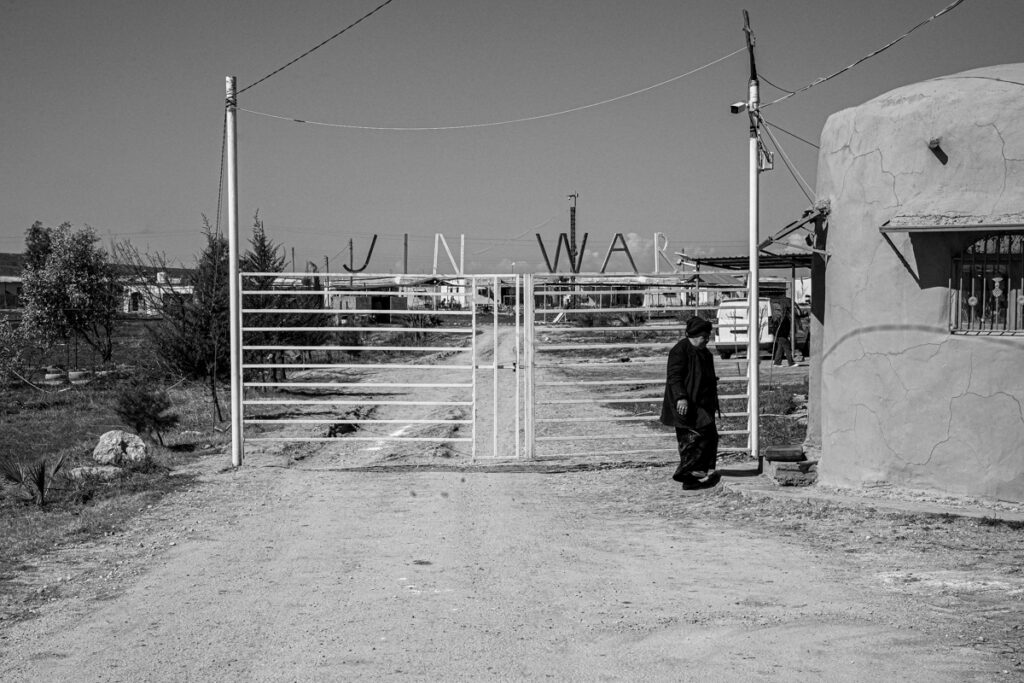
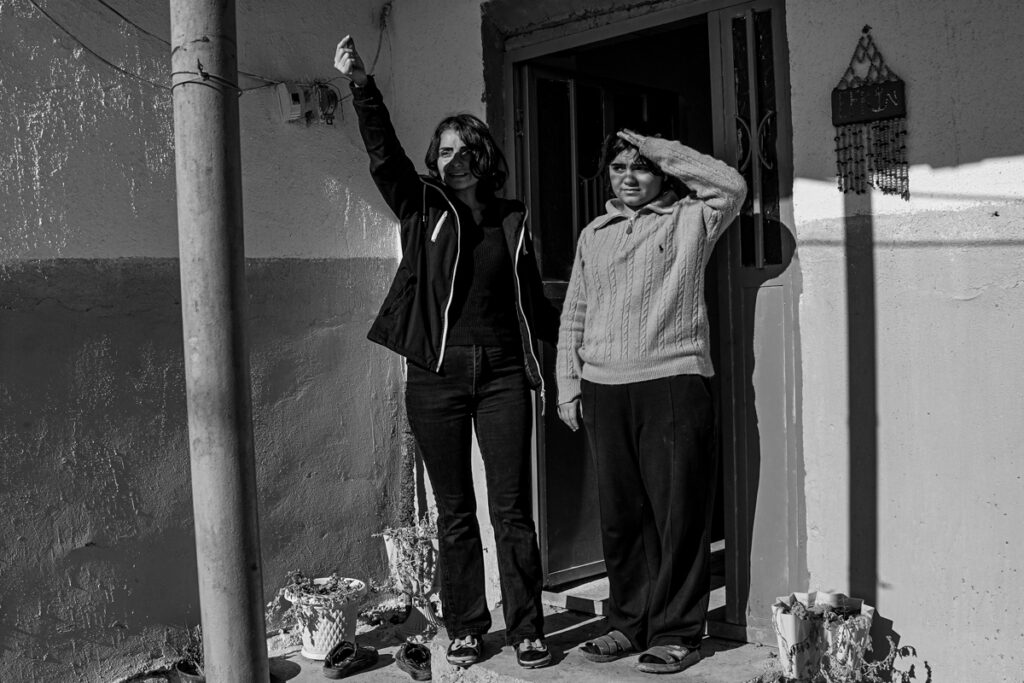
The two most important Kurdish strongholds in the region are Qamishlo and Hasseke, about 80 kilometres apart. Jinwar, or the women’s village, lies roughly in the middle, further north, almost hugging the Turkish border. That is where I meet Yesmin, a 36-year-old woman, who lives in the village with her 13-year-old daughter.
The birth of a village
Jinwar officially opened in November 2018, but the process of establishing it began years earlier.
The idea of building a women’s village emerged from books and teachings, such as Jineology, a form of feminism and gender equality championed by Abdullah Öcalan, the long-imprisoned founder of the Kurdish Workers’ Party (PKK).
The Kurdish women’s movement had also discussed the idea of an all-women’s village for years. But serious plans to construct the village began in 2016 through an initiative of several women’s organisations, including Kongra Star, the Free Women’s Foundation, the Jineolojî Academy, and the Martyr Families Council. The agricultural cooperative of Aboriya Jin, the women’s economic committee, once cultivated the land before donating it to the new project.
Construction of the village began in earnest in 2017. The houses are simple, made of bricks of earth, water, and straw. Some of the buildings feature murals that reflect the spirit and message of the Kurdish struggle. Women in Kurdish society are widely respected as life-givers and protectors, which is why they have become symbolic figures in women’s struggles worldwide.
Some women choose to enter the military, joining the Women’s Protection Units (TP) in Syrian Kurdistan or the Peshmerga forces in Iraqi Kurdistan.
However, such progressive views on women’s rights and role in society contrast with more conservative traditions in parts of the region. Even though there are roughly 60 million Kurds in Turkey, Syria, Iraq, and Iran – roughly the population of the United Kingdom – leaders in the region generally reject their political aspirations.
Gardens and diesel
Today, Jinwar sits on several acres of dusty, dry land. Around forty small homes lie in a crescent. Each dwelling has its own small garden where families plant crops.
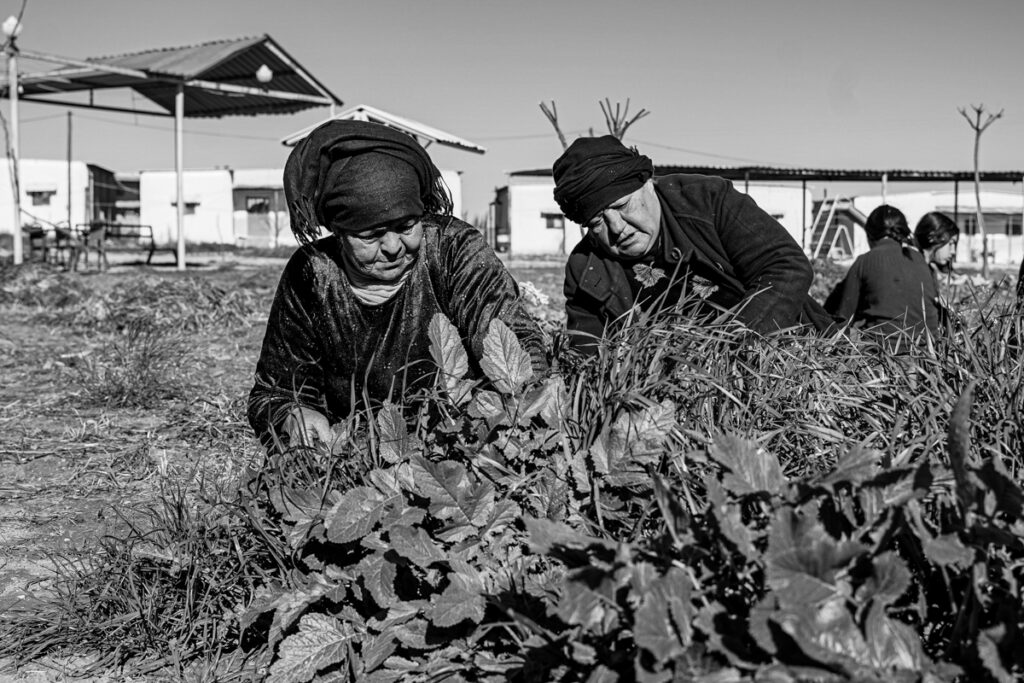
At the centre lies a larger communal garden where residents grow vegetables such as cabbage, carrots, lettuce, and tomatoes. A small building topped with solar panels sits nearby, while many more panels line the outside of the property. As we walk along the main pathway in the midday sunshine, we see a group of elderly women, on their hands and knees, cleaning and maintaining the garden.
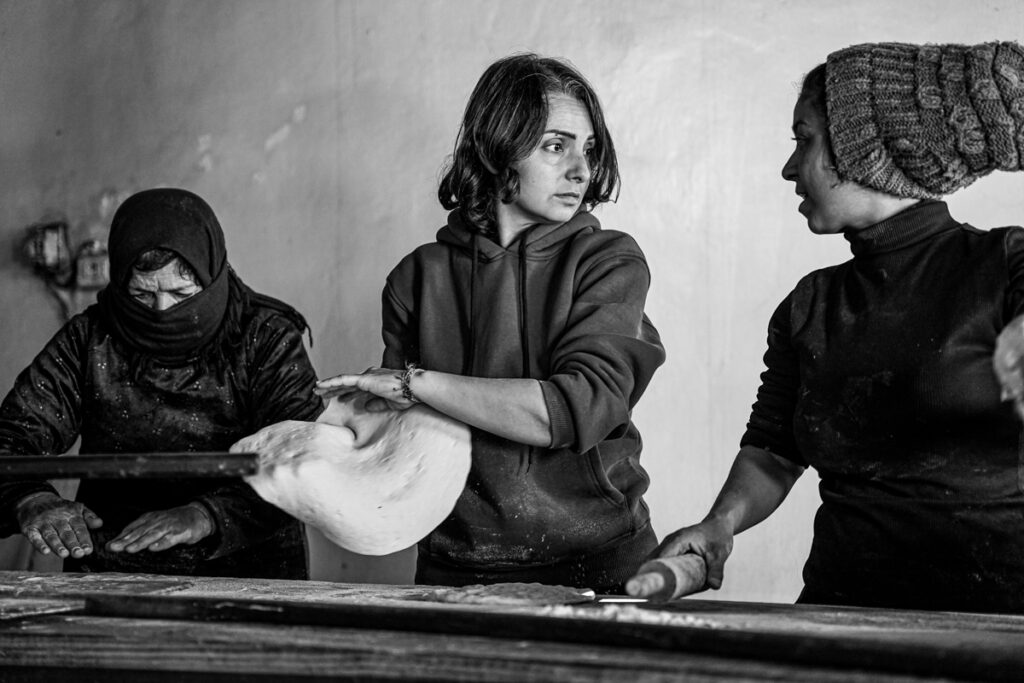
The smell of burning diesel fills the air as the bakery churns out weekly supplies. The number of residents fluctuates with need, but currently the village houses around thirty families, some with children and some without. Residents say they have never turned anyone away. If no home is available for a new resident, they simply share.
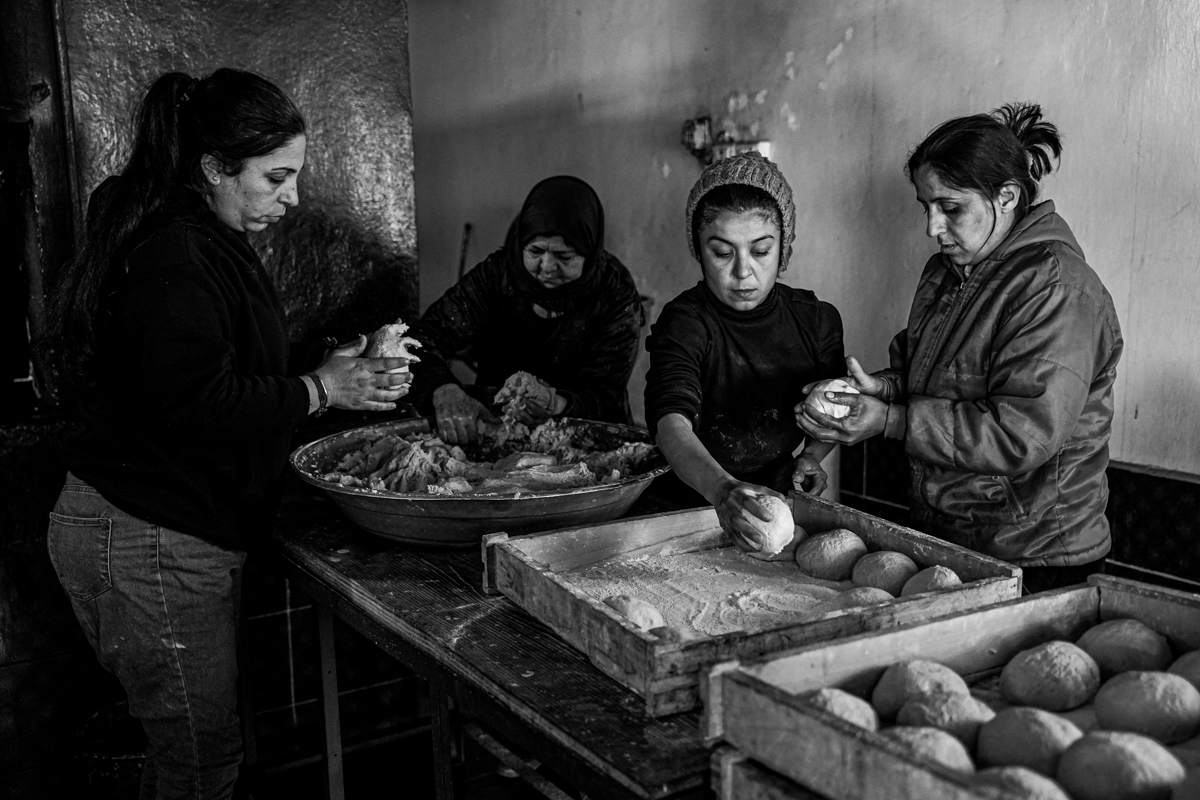
A small homoeopathic clinic serves the community, and a bakery produces traditional Kurdish
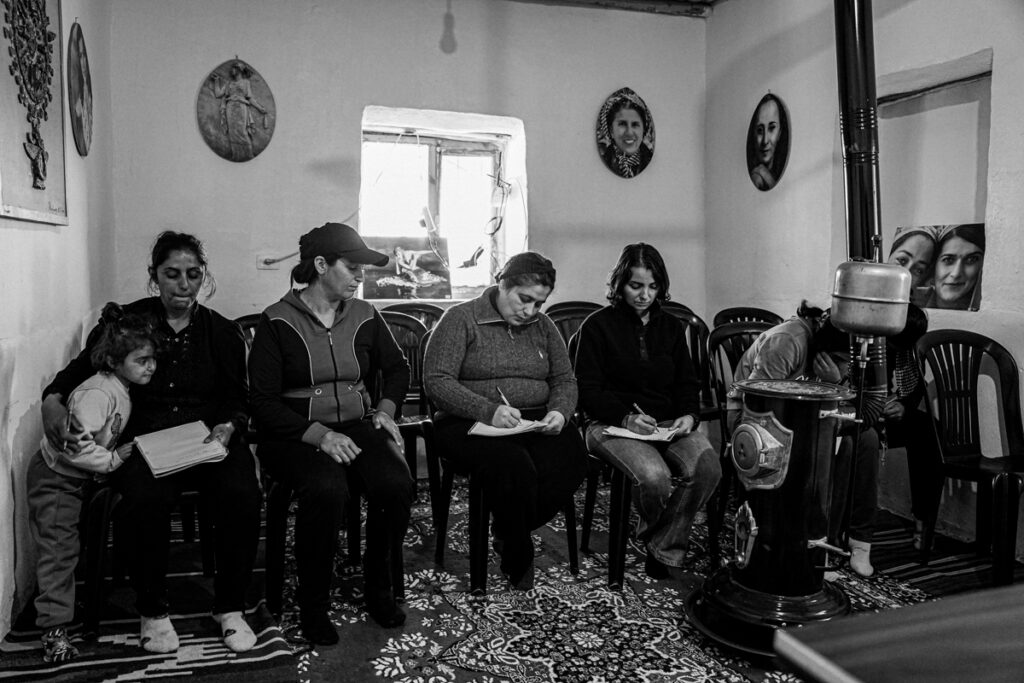
tannour bread once a week on Fridays. Nearby stands a tiny classroom with three or four desks for younger children, which a confident young girl named Shílan proudly shows off. There are also optional Kurdish language classes for adult women who do not speak the language.
As we sit in the communal area, a room lined with patterned cushions on all sides, Yesmin, who has sallow skin and shoulder-length black hair that keeps falling in her face, lights a long, slender cigarette, sips traditional coffee from delicately decorated ceramic cups, and begins to tell me how she arrived in Jinwar nearly six years ago.
Yesmin leaves home
Yesmin’s family comes from the city of Afrin, a Kurdish stronghold on the Turkish–Syrian border, but she was born in Aleppo in 1990. She was the eldest among her siblings, one sister and two brothers. They grew up in a small, stable family that faced few problems.
Yesmin did not enjoy school while growing up and often said she wanted to quit. Eventually, at
fifteen, she did. Her family did not oppose the decision, though she would later deeply regret it.
Yesmin married her cousin, Mustafa, a common decision that allowed them to maintain property and belongings within the extended family. Together, they had two children, a boy named Amid and a girl named Evin.
At the beginning of their marriage, they lived a relatively happy life. But things got more complicated when the war in Syria started in 2011. Their relationship gradually grew strained, particularly as Yesmin’s ideological views began to differ from her husband’s. At that time, she believed that Bashar al-Assad, the Syrian strongman, was a good president who was defending the rights of the Syrian people.
As the situation in Syria worsened, her family decided to relocate to Germany when the opportunity became possible. Her husband was strongly opposed to the idea, and it created a wedge between them. Still, they tried to maintain stability for the sake of their children.
Eventually, however, the couple agreed to separate and ultimately divorce. Yesmin decided it would be best to migrate with her children and join her family abroad. She left Aleppo with her daughter and headed toward Qamishlo, planning to leave Syria for Iraqi Kurdistan and continue onward. Her son stayed with his father.
A place run by women
When she arrived in Qamishlo, she discovered that the crossings were closed due to the war. With no option to leave, she sought help from organisations that support women in difficulty.
With nowhere else to go, one of the organisations advised Yesmin to visit the village of Jinwar and stay there temporarily until the borders reopened.
Initially, she was curious about the idea of a place run exclusively for women. She arrived as a guest, intending to stay only a week or two to clear her mind. But she quickly realised that Jinwar was not simply a shelter for women facing danger or threats. It was a fully integrated community – economic, social, and political – where women could develop themselves and improve their skills.
“When I saw all of this, I changed my mind,” she tells me. “I no longer wanted to leave the country. I wasn’t seeking money or luxury. I had lived a comfortable life with my family in Aleppo when our financial situation was good. I wanted to try depending on myself without relying on a man.”
Yesmin’s family was afraid she would not be able to manage on her own. But despite their insistence that she continue her journey abroad, she ultimately decided to stay in Jinwar.
After speaking with the village authorities and requesting to remain as a permanent resident, she found a new home.
“Every day I live here,” she says, “I discover the importance of this place for women, how it improves their awareness, personality, and lifestyle intellectually, and provides many work opportunities.”
From refugee to community leader
Before arriving in Jinwar, Yesmin had no real work experience. In Aleppo, she had once enrolled in an English-language course but never completed it. In her new community, she discovered many opportunities.
At first, she struggled with tasks like agricultural work, which she found physically exhausting. But she adapted gradually.
She began working in the village shop, which required her to learn commercial skills such as buying, selling, stocking goods, and calculating profits.
“It was complicated at first,” she recalls, “but with time it became easier.”
Yesmin built relationships with traders and gradually became successful in the role. Later, she enrolled in a sewing course, and the community opened a sewing workshop. She was determined to participate in every available activity and take on every responsibility.
Eventually, Yesmin took over the village’s financial matters, a role she still manages today. She also became interested in more technical work, such as installing solar energy systems, water pumps, and electricity infrastructure. She completed training courses and learned how to maintain those systems. Her appetite for learning seemed endless.
Recently, she was elected to the village administration and now serves as a spokesperson for the community.
A fragile existence
Despite their successes, the women of Jinwar know their experiment exists in a fragile environment.
Alia Othuman, a woman who moved to Jinwar to deepen her studies in Jineology, admits that life in the village is not without difficulties.
“The mentality of our enemy is not the mentality of an army,” she says, “but that of a jihadist aiming to remove the value of women.”
Alia worries about what might happen if hostile forces were ever to invade the region.
“We have already seen what happened to other women in Syria. This place is a sanctuary, but the security situation is one of our biggest concerns.”
The community does not consider Ahmad al-Sharaa, Syria’s new leader, a legitimate president. They believe he did not come to rebuild the country but to destroy what remains of it.
“Why are women and children always targeted?” Alia asks. “Why were minorities like Alawites, Druze, and Kurds killed? Why are women and children, especially from these minorities, kidnapped by these groups?”
“In reality, they are afraid of the educated, strong woman, because she is the one who builds society and raises children,” she added.
The women of Jinwar say they want to build a democratic society based on equality between men and women.
“This way, there will not be problems between husband and wife,” Alia explains. “Families will be
built on a correct foundation, leading to a healthy society.”
A bittersweet reunion
Yesmin has learned many skills since arriving in Jinwar and is now one of the village’s most experienced members. Alongside two colleagues who arrived around the same time, she helps guide new residents as they settle into the community.
One day, she would like to return to the wider society. But for now, she considers it her responsibility to support new members and offer them the same kindness she received when she first arrived. Her greatest hope is that her daughter will complete her studies and eventually attend university.
Soon, her mother will visit her in Syria from Germany.
“We haven’t seen each other for sixteen years,” Yesmin says. “When I think about it, it’s painful.
When I see my mother, I know I will remember all the difficulties I went through here alone.”
Many of the passengers on the bus back to Syria once found refuge in Europe. Not long ago, Europeans watched on their phones and television screens as barrel bombs fell, decimating Syrian cities. One of the most widely reported events was the Battle of Aleppo in 2012, when Yesmin was still living there.
Today, more than a million refugees from conflicts around the world call Europe home. But the continent’s attitude toward refugees has since cooled amidst uncertainty and political fatigue. Some European governments say they are ready for Syrians to return home.
Soon, Yesmin’s mother will bounce along that same pontoon bridge over the Tigris, filled with excitement as she finally returns to see her daughter again. It will be a reunion full of joy and pain.
James Forde is an Irish freelance photographer based in London. His work focuses on long-term documentary projects that investigate under-reported socio-political issues. His photography has been featured in numerous publications, including the Washington Post, El País, VICE, and the Irish Times.